How Do I Improve My Website Ranking on Google? A Complete, No-Nonsense Guide for Indian Businesses
Imagine this scenario: You have invested a significant amount of capital, time, and creative energy into building a beautiful website. Whether you are running a luxury real estate agency in Mumbai, a multispecialty hospital in Delhi, a high-tech IT consulting firm in Bengaluru, or an artisanal e-commerce brand shipping nationwide from Surat and Ahmedabad, your digital storefront looks stunning.
But there is a major problem.
Nobody can find you on Google.
Your website is buried deep on page two, three, or even further back in the search engine results pages (SERPs). Instead of receiving a consistent stream of qualified customer inquiries, your inbox is quiet, and your analytics dashboard shows minimal organic traffic.
If you are struggling to gain traction and constantly asking yourself, “How do I improve my website ranking on Google?”, you are in the right place.
In this comprehensive guide, the strategy team at Shivwebsindia breaks down the exact, actionable steps required to rank high in today’s complex search landscape. This isn’t just about classic SEO; we cover the modern search ecosystem, including Google’s AI Overviews, ChatGPT Search, Gemini, Perplexity, and voice search.
The Quick Answer: Google Search-Ready Featured Snippet
How can you improve your website ranking on Google?
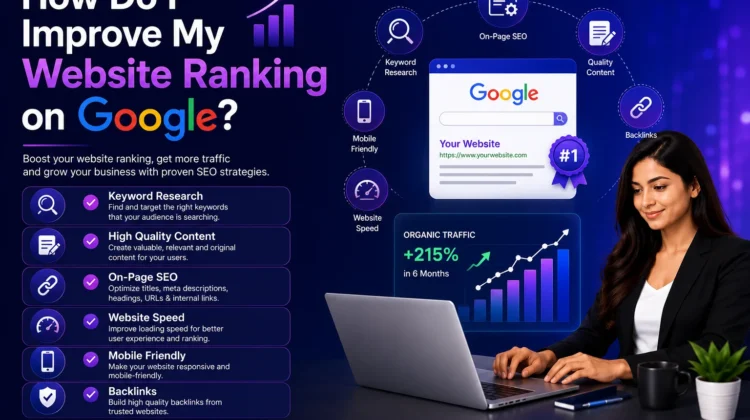
To rank on Google’s first page under the modern Helpful Content System, you must focus on three core pillars:
- Technical Soundness: Build your site on clean, fast architectures such as custom WordPress Development for service platforms or scalable Ecommerce Website Development for online stores. Ensure your site is secure (HTTPS), highly responsive on mobile, and optimized for Core Web Vitals (LCP, INP, CLS).
- High E-E-A-T Content: Produce original, deeply researched content that satisfies clear user intent and showcases Experience, Expertise, Authoritativeness, and Trustworthiness (E-E-A-T).
- Entity & Authority Building: Earn high-quality backlink references from reputable sources, fully optimize your Google Business Profile for localized searches in target markets (like Chennai, Pune, Kolkata, and Hyderabad), and implement structured Schema data so AI engines can easily read and reference your brand.
1. Problem Identification: Why Your Website Is Failing to Rank
Before applying solutions, we must diagnose why your website is currently invisible to search engines.
If you run a packers and movers company in Noida, a specialized healthcare clinic in Indore, a law firm in New Delhi, or an educational institute in Jaipur, your ranking issues generally stem from these four critical structural and strategic flaws:
[Low Google Ranking] ──┬──> Outdated Website Platform (Poor UX, Slow Page Speed)
                       ├──> Lack of Topical Authority & E-E-A-T (Thin Content)
                       ├──> Missing Local SEO & Entity Optimization (No Google Map Pack)
                       └──> Bad Technical Setup (Indexing issues, Broken Links)
A. Poor Core Platform Architecture
Many businesses choose cheap, automated page builders or poorly coded templates. These platforms create bloated HTML code, slow down server response times, and prevent search engine crawlers from reading your content. If Google’s bots struggle to crawl your site, your pages will not be indexed properly.
B. The “Me-Too” Content Trap (Lack of Originality)
Google’s Helpful Content System is designed to identify and devalue unoriginal content. If your blog posts or service descriptions look exactly like those of your competitors in Pune, Lucknow, or Chennai, Google has no reason to prioritize your pages. Mass-producing generic, AI-spun content without human editing or real-world case studies will often result in a ranking drop.
C. Ignoring Mobile-First Indexing
In India, more than 80% of all search queries—whether searching for an emergency doctor in Patna or looking for interior designers in Thane—originate on mobile phones. If your website takes more than 3 seconds to load on a mobile connection, users will bounce back to the search results. Google recognizes this behavior and will lower your rankings accordingly.
D. Missing Trust Signals (E-E-A-T Deficiencies)
Google prioritizes user safety, especially for YMYL (Your Money Your Life) websites, such as those in healthcare, finance, legal services, and real estate. If your website lacks author bios, verifiable customer reviews, a clear physical address in your operating cities (e.g., Bangalore or Hyderabad), and transparent privacy policies, search engines will flag your site as low-trust.
2. The Strategic Matrix: What, Why, How, Benefits, Costs, Risks, & Best Practices
To make the best decisions for your digital presence, you need a clear overview of the organic search landscape:
| Dimension | Strategic Details |
|---|---|
| What is it? | Website Ranking Optimization is the process of aligning your website’s code, structure, user experience, and content with search engine algorithms and generative AI models to maximize organic search visibility. |
| Why do you need it? | Organic rankings drive highly targeted, high-intent traffic directly to your site. Unlike paid ads (PPC), where traffic stops the moment you turn off your ad budget, organic SEO acts as a long-term digital asset that continues to generate value over time. |
| How does it work? | By launching your site on high-performance frameworks (via WordPress Development or custom Ecommerce Website Development), publishing authoritative content, fixing technical bugs, and building high-trust local footprints. |
| What are the Benefits? | • A steady stream of organic, high-intent inbound leads.<br>• Significantly reduced customer acquisition costs (CAC).<br>• Enhanced brand authority in competitive metropolitan hubs.<br>• Better overall user experience, leading to higher on-site conversion rates. |
| What are the Costs? | The investment varies based on your industry, geographic targets, and competition. Ranking a local private clinic in Vadodara requires a different level of investment than managing nationwide optimization for an enterprise-level e-commerce platform. |
| What are the Risks? | Engaging in high-risk, “black-hat” practices (such as buying cheap link packages, link-spamming, cloaking, or keyword stuffing) can trigger a manual penalty from Google, which can remove your site from search results entirely. |
| What are the Best Practices? | Build websites with a user-first mindset. Keep page speeds high, use secure HTTPS encryption, implement clean JSON-LD Schema structures, and provide original, peer-reviewed content that directly answers search queries. |
3. Selecting the Right Foundation: WordPress vs. Custom E-commerce Development
Your search engine rankings are only as stable as the technology your website runs on. Google prefers fast, accessible, and clean platforms.
At Shivwebsindia, we focus on two highly effective developmental tracks depending on your business goals:
Path A: Custom WordPress Development (Best for Service Businesses & B2B)
For law firms, educational institutions, real estate developments, healthcare facilities, and logistics companies, WordPress Development offers an incredibly flexible foundation.
                  ┌────────────────────────────────────────┐
                  │       Custom WordPress Engine          │
                  └───────────────────┬────────────────────┘
          ┌───────────────────────────┼───────────────────────────┐
          ▼                           ▼                           ▼
   Clean Semantic HTML         Easy Schema Insertion       Rapid Content Publishing
(Helps search engines crawl) (Local Business, FAQs, etc.) (Targets long-tail queries)- Clean Code Structure: Custom-coded WordPress websites limit unnecessary code, making it easy for search engine crawlers to parse your pages.
- Schema Integration: You can easily implement structured data markup (such as LocalBusiness, FAQ, and Article schemas).
- Scalable Content Hubs: A built-in blogging system allows you to quickly publish articles to target long-tail search queries (e.g., “How to choose an estate planning lawyer in Bangalore” or “Top luxury interior design trends in Kolkata”).
Path B: Specialized Ecommerce Website Development (Best for Online Stores)
If you are running an online store selling apparel from Surat, handmade goods from Jaipur, or specialized items from Nagpur, you need an Ecommerce Website Development plan tailored for product search optimization.
- Faceted Navigation Optimization: We structure product filters (like size, color, and price) correctly so search engines don’t waste crawl budget on duplicate URLs.
- Fast Loading Product Pages: We optimize high-resolution product images, minify javascript, and use global Content Delivery Networks (CDNs) to keep product load times under 2 seconds.
- Highly Secure Platforms: Safe checkouts, SSL certificates, and visible trust badges are critical ranking signals for commercial platforms.
4. Step-by-Step Blueprint to Rank High on Google
Let’s walk through the exact, step-by-step methodology to help your business transition from invisible to highly visible:
Step 1: Execute a Technical SEO and Page Speed Audit
If your website cannot be crawled or has slow page speeds, other optimization efforts will go unnoticed.
- Verify Indexation: Open Google Search Console and inspect the “Indexing” report. Ensure all of your critical service and product pages are fully indexed and free of crawl errors.
- Optimize Core Web Vitals: Go to PageSpeed Insights and test your key landing pages. Aim for these targets:
- Largest Contentful Paint (LCP): Under 2.5 seconds (measures loading performance).
- Interaction to Next Paint (INP): Under 200 milliseconds (measures page responsiveness).
- Cumulative Layout Shift (CLS): Under 0.1 (measures visual stability).
- Fix Broken Redirects: Locate and fix any broken links (404 errors) and replace long redirect chains with direct 301 redirects to improve crawl efficiency.
Step 2: Implement Semantic Keyword Research & Search Intent Mapping
Modern search engines do not rely on exact-match keywords. Instead, they use advanced semantic models to analyze the overall context of your content.
- Map Search Intent: Categorize your target keywords into four distinct groups:
- Informational: “How to apply for a home loan in Mumbai”
- Navigational: “Shivwebsindia web development portfolio”
- Commercial: “Best digital marketing packages in Delhi”
- Transactional: “Hire a WordPress developer in Bangalore”
- Create Topical Hubs: Rather than writing isolated articles, organize your content into logical clusters. For example, if you build a cluster around “Ecommerce Website Development”, you should also create supporting articles on payment gateway integration, secure checkout design, and product page optimization. Link these pages together to build topical authority.
                       ┌────────────────────────────────┐
                       │     Topical Pillar Page:       │
                       │ Ecommerce Website Development  │
                       └───────────────┬────────────────┘
          ┌────────────────────────────┼────────────────────────────┐
          ▼                            ▼                            ▼
┌──────────────────┐         ┌──────────────────┐         ┌──────────────────┐
│  Payment Gateway │         │ Secure Checkout  │         │   Product Page   │
│   Integration    │         │      Design      │         │   Optimization   │
└──────────────────┘         └──────────────────┘         └──────────────────┘
Step 3: Write Helpful, E-E-A-T Aligned Content
Google relies on human quality raters to ensure that search results are useful, accurate, and safe. Your content should reflect these standards:
- Experience: Share real-world examples, actual project photographs, and case studies. For instance, an interior design firm in Pune should display real, step-by-step progress photos of a kitchen renovation rather than relying solely on stock photos.
- Expertise: Author bio boxes should be added to articles, especially in YMYL industries. A medical article on a clinic’s website in Ludhiana should be written or reviewed by a credentialed physician, with links to their professional credentials.
- Authoritativeness: Build trust by citing credible studies, government portals, and established industry research reports.
- Trustworthiness: Make your contact information, physical addresses, pricing structures, and refund policies clear and easy to find on your website.
Step 4: Localize Your Organic Footprint (Local SEO)
If your services target specific geographic regions, local optimization is critical to capturing nearby customers.
- Optimize Your Google Business Profile: Claim and verify your listing. Keep your business name, address, and phone number (NAP) completely consistent across your website and other web directories.
- Create Localized Landing Pages: If your logistics company operates in multiple cities like Visakhapatnam, Pimpri-Chinchwad, and Nashik, write distinct local service pages for each city. Highlight localized details, such as regional landmarks, local team profiles, and specific client testimonials from those areas. Avoid duplicating content across these pages; keep each page unique.
- Gather Real Customer Reviews: Ask satisfied clients to leave detailed, keyword-rich Google reviews describing the exact services you provided.
Step 5: Optimize for Generative AI & Answer Engines (GEO)
AI Overviews (SGE), Perplexity, Gemini, and ChatGPT Search extract key data points from high-performing websites to answer user queries directly.
- Be Direct and Concise: Start your informational articles with a clear, direct answer to the primary question in the first two sentences. Use bullet points or numbered lists to make your answers easy for AI engines to scan.
- Implement Structured Schema Data: Use Product, Organization, and LocalBusiness Schema scripts to help search engines understand the exact relationships between your products, locations, and brand identity.
- Use Clear Headings: Organize your pages with logical heading hierarchies (H1 for page titles, H2 for main topics, H3 for subtopics). This makes it easy for both search engines and humans to read through your content.
5. Insider SEO Strategies (Expert Tips)
Here are several strategies we use at Shivwebsindia to help our clients stand out in highly competitive markets:
- Optimize Your Internal Link Flow: Link your informative blog posts back to your high-converting landing pages. This passes search authority (link juice) to your commercial pages and helps Google index your entire site more effectively.
- Aim for 10x Content Quality: Analyze the top three results for your target search term. Your goal is to create content that is significantly more comprehensive. Add step-by-step videos, custom calculators, downloadable checklists, and clean infographics to deliver more value than anyone else.
- Perform Regular Content Audits: Outdated content naturally drops in search rankings. Audit your older blog posts once a year. Update old statistics, improve your formatting, and fix any outdated links to maintain your rankings.
- Target Conversational Voice Search: Voice searches are typically longer and phrased as complete questions. Focus on conversational, long-tail phrases (such as “Which web development agency in Indore offers custom WooCommerce integration?”) to capture this growing search audience.
6. Common Pitfalls that Hurt Your Website Rankings
Avoid these common technical and strategic mistakes:
- Purchasing Cheap Backlink Packages: Buying automated backlinks from low-quality, spammy websites can trigger a manual search penalty, which can drop your rankings overnight. Focus on earning high-quality, editorial links naturally.
- Publishing Duplicate Content: Avoid copying product descriptions directly from manufacturer catalogs or replicating service pages for different locations. Google penalizes websites that use repetitive, low-value content.
- Neglecting Your Title Tags and Meta Descriptions: These fields act as your digital billboard on search pages. Keep title tags under 60 characters and meta descriptions under 155 characters. Make them compelling to encourage more users to click.
- Using Bland, Unedited AI Content: Publishing raw, unedited AI-generated content can lead to a drop in search visibility under Google’s Helpful Content guidelines. Always edit AI content to add human expertise, real-world examples, and your brand’s unique voice.
7. Frequently Asked Questions
Q1: How long does it take for a website to rank on the first page of Google?
Answer:
There is no fixed timeline for SEO success. Generally, a brand-new website takes 3 to 6 months of consistent technical optimization and content production to start ranking for low-to-medium competition terms. For highly competitive markets (like finance, real estate, or national e-commerce), achieving top rankings can take anywhere from 6 to 12 months of continuous, high-quality optimization.
Q2: Can I rank my WordPress website without advanced coding knowledge?
Answer:
Yes. Custom WordPress Development provides a highly accessible platform for non-developers. By using reliable SEO plugins like RankMath or Yoast, you can easily manage meta tags, generate XML sitemaps, and add basic schema markup. However, optimizing your page speeds, resolving code bloat, and creating custom page designs generally require the expertise of a professional web developer.
Q3: Does Google penalize AI-generated content?
Answer:
Google’s official guidelines state that AI-generated content is not penalized simply for being created by AI. However, Google’s Helpful Content System evaluates whether your content is original, high-quality, and written primarily to help users. If you publish unedited, repetitive, or low-value AI text designed only to manipulate search engines, your website rankings will likely drop.
Q4: How does Local SEO help my business grow?
Answer:
Local SEO is designed to capture highly targeted traffic in specific geographic regions, such as Chennai, Delhi, Pune, or Vadodara. By optimizing your Google Business Profile and building local directory citations, your business can appear in Google’s Local Map Pack. This is highly valuable for service-oriented businesses like dental clinics, packers and movers, law firms, and local retail stores.
Q5: Which website platform is best for e-commerce SEO?
Answer:
Successful Ecommerce Website Development requires a platform that can handle fast-loading pages, secure payment checkouts, and clean product URL structures. WooCommerce (for WordPress) is excellent for content-heavy online stores, while platforms like Shopify are highly effective for direct-to-consumer brands. For large-scale online stores, custom headless frameworks can offer the best loading speeds and SEO flexibility.
8. Conclusion: The Path Forward
Improving your search ranking on Google is an ongoing process of optimization, adaptation, and technical maintenance. Google’s algorithms continue to evolve to prioritize helpful, high-trust, and user-centric websites.
To maintain strong search rankings, focus on these core pillars: fast loading speeds, clean platform code, high-value content, and clear trust signals.
Let’s Build Your Search Visibility Together
Whether you are a real estate agency in Gurgaon, a manufacturing business in Thane, an import-export company in Kolkata, or an e-commerce brand in Bengaluru, you need a web development partner who builds platforms optimized for both search engines and human users.
At Shivwebsindia, we build custom WordPress Development layouts and high-performance Ecommerce Website Development platforms designed to maximize your visibility in modern organic search results.
Ready to grow your search traffic?
[Contact Shivwebsindia Today for a Free SEO & Technical Audit]
- Website: www.shivwebsindia.com
- Our Core Services: Custom Web Design, Responsive WordPress Development, High-Conversion E-commerce Platforms, Technical SEO Audits, and Generative Engine Optimization.